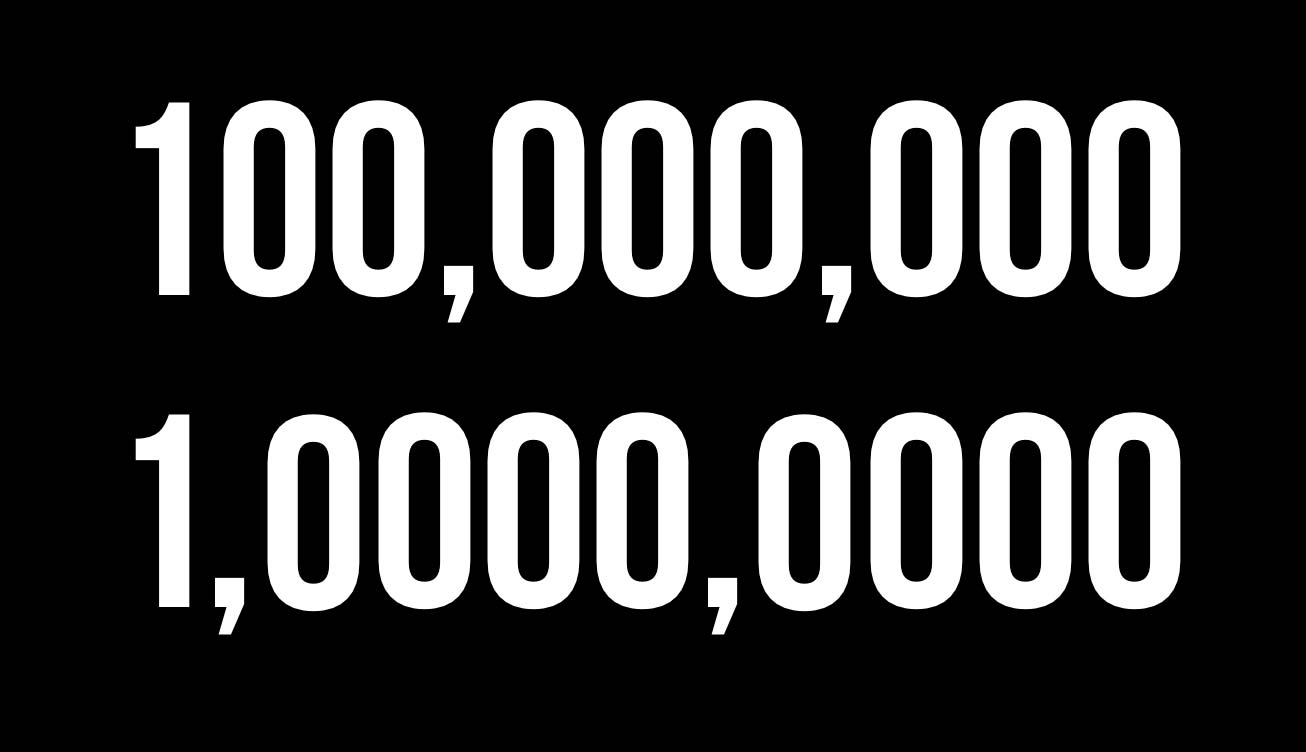
🎐 XC Scribbles 117 - ✨ The Shift from Thousand to Ten Thousand
When I first heard Malaysians and Singaporeans say “ten thousand” as “ten thousand” in the literal sense of “ten thousand,” I felt slightly unsettled.
It wasn’t that I didn’t understand. I understood perfectly. It just didn’t flow. It felt as though a sentence had skipped a turn.
We share the same cultural roots so why not use “wan” (萬), the ten-thousand unit embedded in Chinese numerical structure? That quiet discomfort lingered.
Later I realized something interesting. Among major modern languages, Chinese is one of the few that still preserves ten thousand as a fundamental counting unit. Ancient Greek once had myriad (μυριάς) to represent ten thousand, but over time it dissolved into metaphor and eventually disappeared from everyday numerical structure. English built upward through “thousand,” stacking one layer upon another, without making that conceptual leap.
That was when it clicked.
This is not a mathematical difference. It is a difference in vantage point.
“Thousand” still counts. It is incremental. It is accumulating. “Ten thousand,” in contrast, feels like someone who has stepped back. Someone no longer counting one by one, but taking in the whole landscape at once.
Chinese carries countless expressions built on “wan”: wanwu萬物 (all things), wanxiang (the myriad phenomena), wanmin萬民 (the people), wangu萬古 (eternity). It is not precision, it is scale. It is the feeling of standing between heaven and earth and sensing that the world is too vast to itemize.
In the past, I would have chased the origin. Who came first? Who is correct? Why don’t you use ten thousand? Why do we? I would trace and retrace until the historical threads stretched thin. And somewhere along that pursuit, I would forget the beginning: I was simply reacting to a rhythm that felt slightly off.
Eventually, I began to see that systems of measurement within language are not meant to standardize humanity. They are meant to allow people to live fully inside their own cultural frame.
Some people need to confirm safety one thousand at a time. Others are accustomed to surveying the horizon ten thousand at a time. Neither is superior. They are simply standing in different places.
In the Chinese structure where “ten thousand ten thousands make one hundred million,” I sense a kind of imagination that rises toward the sky. It is not about exactness. It is about boldness. Not control, but trust that the world is already that vast.
Perhaps what language truly does is not teach us how to calculate correctly. It quietly determines where we stand when we look at the world.
—— XC Scribbles · 壹佰壹拾柒 CXVII 🔢卍
‹ 🎐 XC Scribbles 118 - ✨ Pause Is the Seam of Civilization
🎐 XC Scribbles 116 - ✨ Cleaning Is Not a Chore, It Is Attention ›